Development
If You Bought a $6M+ Landed Home: Rebuild vs A&A Decision Framework for High-Value Homes
-
Su Shiquan
If You Bought a $4M–$6M Landed Home: Where Renovation Costs Usually Blow Out (And How to Control It)
The $4M–$6M landed segment is one of the most common “upgrade bands” in Singapore, and also the band where renovation budgets most often drift.
Why this range is risky:
you have enough budget to aim for “big change”
but not enough buffer to absorb late discoveries + scope creep
many homes are older and have layered renovation history
From a landed house contractor’s perspective, this is the segment where owners start intending “renovation / A&A”, and accidentally end up with rebuild-level complexity without rebuild-level planning.
This article shows where costs blow out, what triggers it, and a contractor-led framework to keep the project controlled.
Where $4M–$6M landed homes are commonly bought (Singapore context)
Homes in this band often appear in:
District 15 (East Coast / Siglap / Katong fringe)
District 19 (Serangoon / Kovan fringe, landed pockets)
city-fringe landed enclaves outside CCR
Common property types:
terrace houses with strong location premiums
semi-detached homes with dated internal layouts
freehold / 999-year stock
Typical $4M–$6M landed transactions (observed)
Area / Estate (Common examples) | Property Type | Land Area (sqft) | Transaction Price | PSF | Tenure |
D15 East Coast enclave | Terrace | ~1,900 | ~$5.60M | ~$2,950 | Freehold |
D19 landed pocket | Semi-D | ~2,900 | ~$5.20M | ~$1,790 | 999-year |
Katong / Siglap vicinity | Semi-D | ~3,200 | ~$5.90M | ~$1,840 | Freehold |
Upper Serangoon area | Terrace | ~2,300 | ~$4.60M | ~$2,000 | Freehold |
What this signals (contractor interpretation)
High PSF often means “location-first purchase” → renovation tends to be more ambitious
Older stock + strong tenure often hides waterproofing/structural issues
Terrace and semi-D are common → A&A is frequently the best value path, but only if planned early
The 5 most common cost blow-out points (and why they happen)
1) Scope creep during design (the biggest budget killer)
In this band, owners often start with:
“renovation + some extensions”
and end up with:“change everything” decisions
Typical scope creep triggers:
“Since we’re hacking, let’s open up more”
“Let’s add a bigger extension”
“Let’s shift the staircase”
“Let’s redo all M&E while we’re at it”
✅ Control move: define a “must-have vs nice-to-have” scope list early.
Renovation, A&A, or Rebuild – Which Should You Choose?
2) Late discovery of A&A requirements
Owners often think they’re doing “renovation only” until:
structural walls are touched
extension is attempted
major internal reconfiguration happens
Then suddenly:
A&A triggers apply
submissions and approvals become necessary
design changes are required
✅ Control move: confirm A&A triggers before design is finalised.
3) Structural strengthening underestimated (or over-engineered)
Two extremes cause budget blowouts:
underestimating strengthening → late variations
over-engineering everything → unnecessary spend
✅ Control move: targeted strengthening aligned to layout outcomes, not fear.
Top Mistakes Homeowners Make When Rebuilding Their Landed House (supports “don’t overdo” mindset)
4) Waterproofing + drainage “surprises”
This is one of the most consistent overspend areas, especially in older homes.
Common hidden issues:
roof membrane deterioration
wet area detailing failure
poor falls/drainage compatibility after layout changes
external water management problems
✅ Control move: treat waterproofing/drainage as a baseline system, not a “later add-on”.
How to Renovate an Old Landed House Safely
5) “Benchmarking” against neighbours or prime districts
This band is where owners compare:
friends with $8–15M landed homes
Instagram renovations
magazine-worthy rebuilds
The result:
rebuild-like ambition
A&A-level constraints
budget mismatch
✅ Control move: anchor scope to your property type + your plot + your budget band, not someone else’s house.
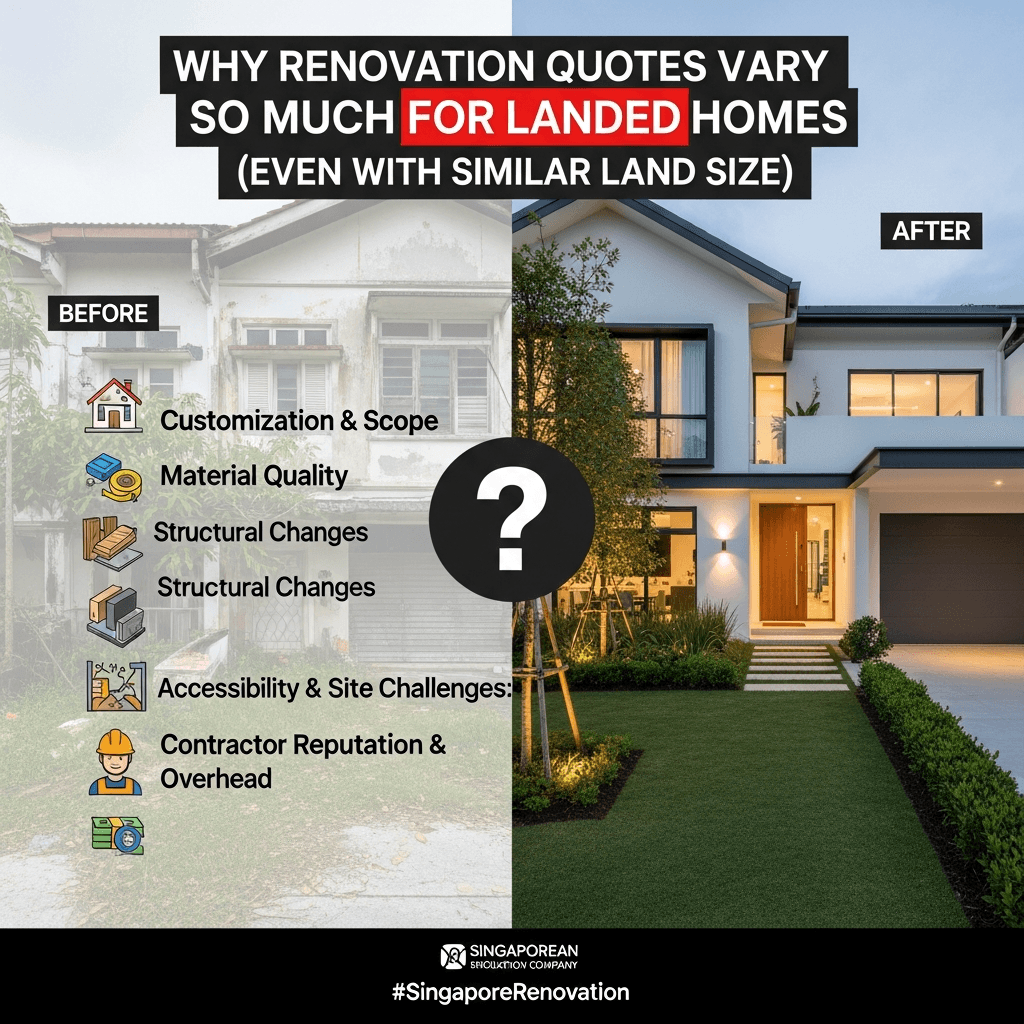
Why Two Homes on the Same Street Renovate Differently: A Price-Per-Sqft Lens
Rebuild vs A&A in the $4M–$6M band (the honest reality)
In this band:
rebuild can seem doable
but cost and timeline risk is often underestimated
A practical rule contractors see play out:
A&A usually wins when structure is workable and space needs are moderate
rebuild wins only when structural/layout constraints are severe and long-term plans justify it
✅ Control move: make the decision early, before design money is sunk.
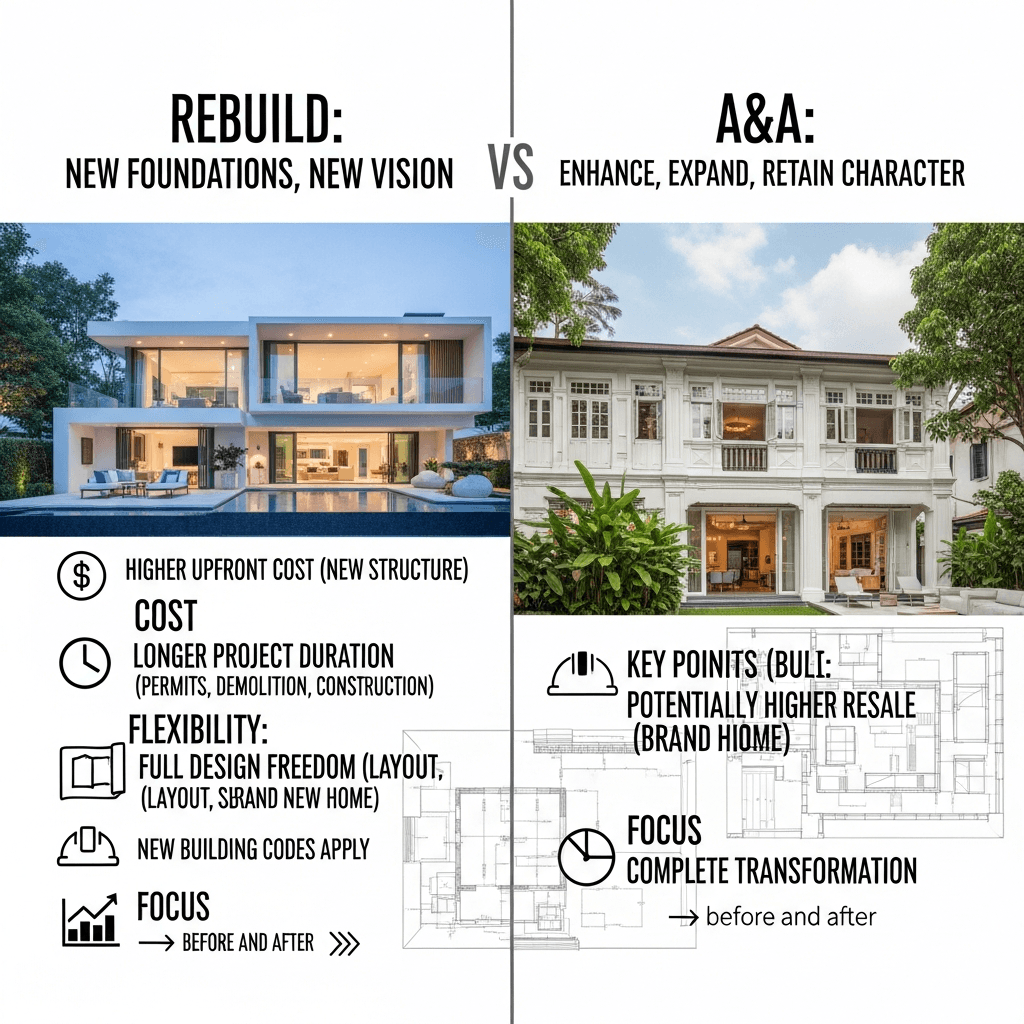
Rebuild vs A&A: Which Is Better for Your Landed Home?
The contractor control framework (step-by-step)
Here’s a simple, repeatable framework used to prevent budget blowouts:
Step 1, Set “Budget + Buffer” correctly
Set a renovation budget
Then set a buffer (for older landed homes)
Do not plan to spend the buffer on aesthetics
Step 2, Decide your renovation category early
Pick one (don’t mix them accidentally):
Renovation-only
A&A (planned)
Rebuild
Step 3, Lock technical scope before finishes
Lock:
structure approach
M&E direction
drainage/waterproofing strategy
extension intent
Then choose:
materials
carpentry
finishes
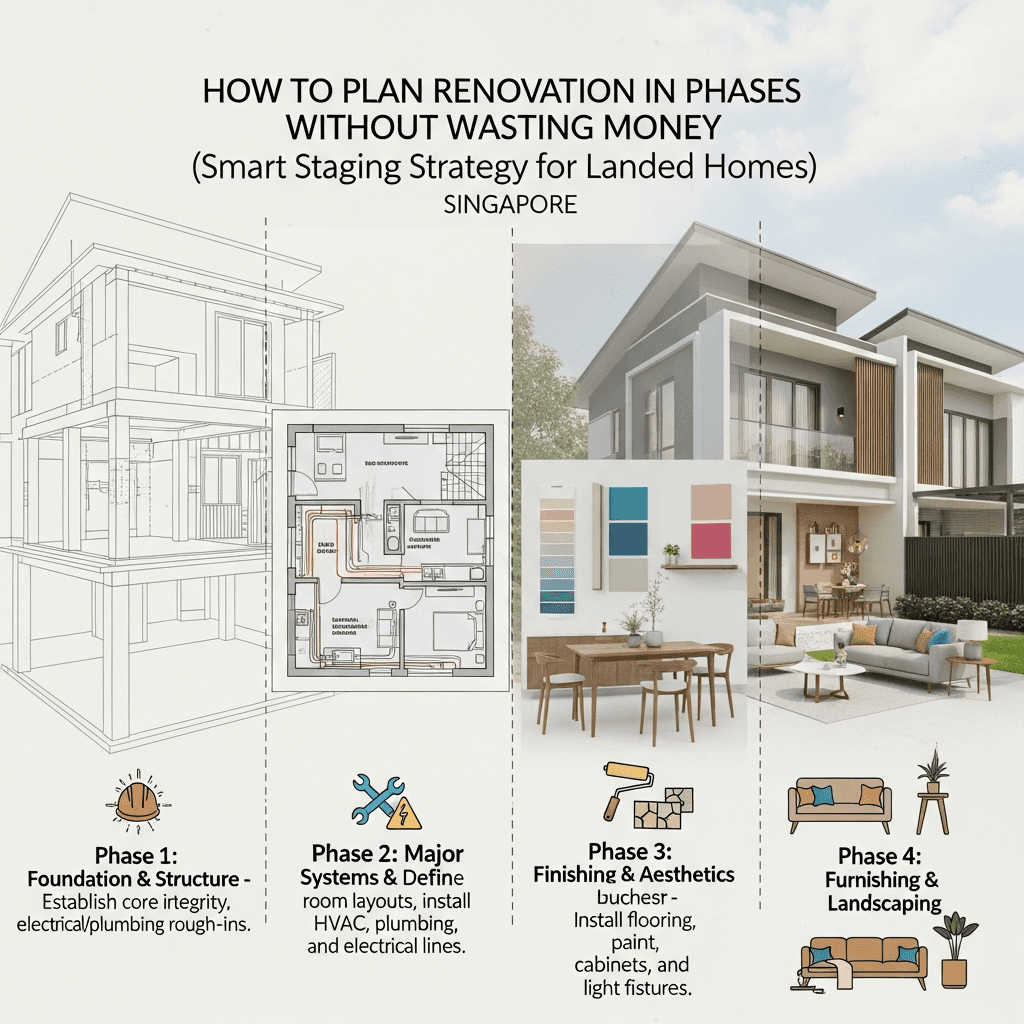
Step 4, Avoid duplicated work through sequencing
If staging is needed:
stage with a masterplan
do waterproofing/drainage systems holistically
avoid repeated hacking
How to Plan Renovation in Phases Without Wasting Money
Step 5, Use contractor-led feasibility checks early
This prevents:
redesign loops
approval surprises
variations during construction
This is why homeowners searching “landed house contractor Singapore” are usually better served by early contractor input than late-stage quoting.
How Ember Earther Builders approaches $4M–$6M landed homes
In this band, Ember focuses on:
scope discipline
early A&A trigger identification
realistic cost/timeline control
buildability-first planning
The goal is not to “do more”, it’s to do the right works once.
If you’ve bought a $4M–$6M landed home in Singapore (common in District 15 and District 19) and you want to avoid budget drift, early engagement with a landed house contractor can prevent expensive scope escalation before construction starts.
Ember Earther Builders supports landed homeowners across Singapore with clarity-first renovation and A&A planning.
FAQ
Why do costs blow out most often in $4M–$6M projects?
Because ambition rises faster than feasibility, and A&A triggers are often discovered late.
Is rebuild safer if I can afford it?
Not necessarily. Rebuild has higher approval and timeline risk; A&A can be safer if structure is workable.
When should I engage a landed house contractor?
Before finalising design and before submissions—early feasibility checks prevent redesign and variations.
Related