Development
Why Two Homes on the Same Street Renovate Differently: A Price-Per-Sqft Lens
-
Su Shiquan
Why Two Homes on the Same Street Renovate Differently: A Price-Per-Sqft Perspective
It’s a question many landed homeowners ask after buying:
“My neighbour paid less, why is my renovation costing more?”
“We’re on the same street, shouldn’t the renovation be similar?”
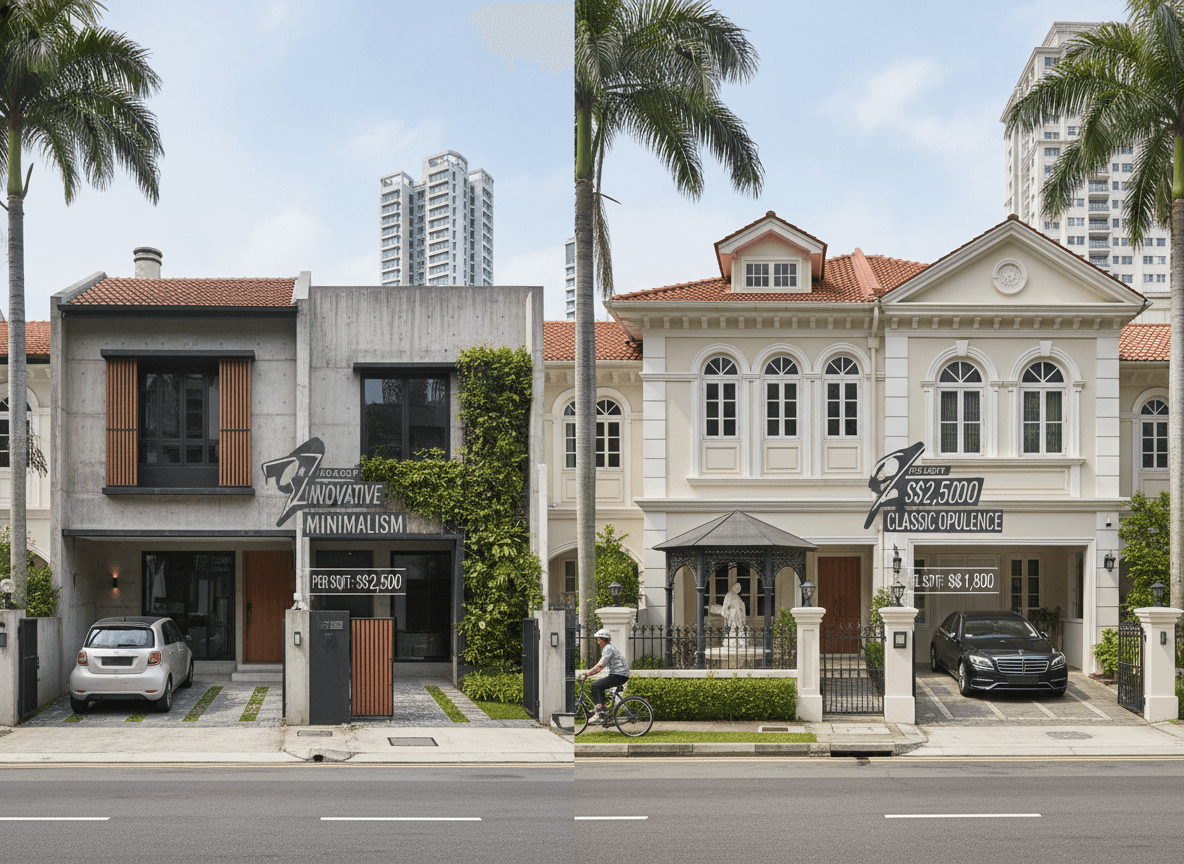
In Singapore’s landed housing market, two homes on the same street can have completely different renovation outcomes, even if land size, tenure, and location look similar.
From a landed house contractor’s perspective, the reason often comes down to price-per-square-foot (PSF), not as a valuation metric, but as a signal of buyer intent and renovation behaviour.
Why PSF matters more than total price for renovation outcomes
Total price tells you:
how much a buyer paid for land
PSF tells you:
how aggressively a buyer entered the market
how much compromise they accepted on building condition
how much renovation ambition usually follows
Higher PSF often means:
stronger location premium
greater tolerance for building issues
higher post-purchase renovation expectations
Lower PSF often means:
better underlying structure
more conservative renovation scope
clearer A&A vs rebuild direction early on
Same street, different PSF, different renovation paths
Below is a simplified illustrative snapshot based on recent landed transactions observed across multiple districts (OCR, RCR, CCR).
(Based on observed URA landed transactions and contractor experience)
Street | Property Type | Land Area (sqft) | Transaction Price (SGD) | Price PSF | Likely Buyer Intent | Typical Renovation Outcome |
Coniston Grove (Serangoon Garden) | Terrace House | 1,840 | $5,680,000 | ~$3,085 | Location-first buyer | A&A with major reconfiguration |
Coniston Grove (Serangoon Garden) | Terrace House | 2,450 | $5,800,000 | ~$2,370 | Structure-first buyer | Renovation with selective A&A |
Tavistock Avenue (Serangoon Garden) | Semi-Detached | 3,120 | $7,180,000 | ~$2,300 | Family upgrader | A&A with staged construction |
Tavistock Avenue (Serangoon Garden) | Semi-Detached | 3,600 | $7,380,000 | ~$2,050 | Long-term owner | Renovation-first, rebuild deferred |
Important: These are behavioural signals, not rules.
But in practice, PSF often correlates strongly with renovation complexity.
What high-PSF buyers usually face after purchase
High-PSF purchases are common in:
District 15 (East Coast)
District 10 (Bukit Timah)
prime pockets of District 19
These buyers often:
prioritise location over condition
accept older layouts
plan to “fix everything later”
Renovation reality:
hidden structural issues surface
layout constraints limit design freedom
A&A triggers appear mid-design
cost escalation occurs due to scope expansion
Price Paid vs Renovation Reality: What Singapore Landed Buyers Commonly Underestimate
What lower-PSF buyers tend to experience
Lower-PSF landed purchases often:
come with better base structure
reflect compromise on micro-location
involve more rational renovation planning
These buyers typically:
decide A&A vs rebuild earlier
control scope better
face fewer mid-project surprises
This is why two homes on the same street don’t renovate the same way, even if they look similar externally.
How PSF affects A&A vs rebuild decisions
From a contractor’s perspective:
Higher PSF homes often:
start with renovation intent
drift into A&A complexity
sometimes reconsider rebuild too late
Lower PSF homes often:
evaluate rebuild earlier
plan A&A more deliberately
sequence renovation works more efficiently
Rebuild vs A&A: Which Is Better for Your Landed Home?
Why PSF-driven renovation differences surprise homeowners
Most buyers:
understand PSF as a pricing metric
do not realise it reflects what they compromised on
Those compromises almost always surface during renovation:
structure
waterproofing
services
compliance
Why Many New Landed Owners Delay Renovation for 6–12 Months (And What It Really Costs)
What a landed house contractor looks for beyond PSF
While PSF is a useful signal, an experienced landed house contractor focuses on:
structural layout
past renovation layers
drainage and waterproofing history
regulatory constraints
feasibility of extension or reconfiguration
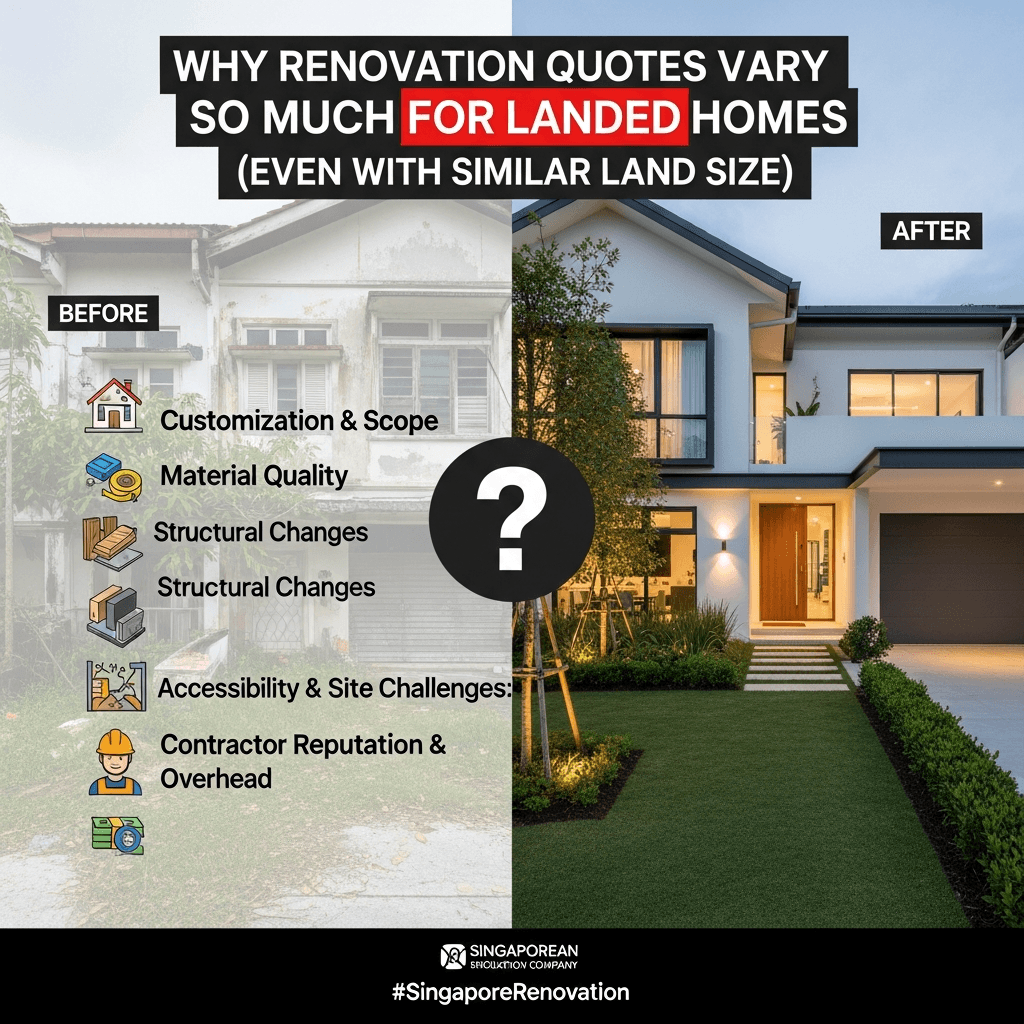
This explains why quote ranges vary widely, even for similar-looking houses.
Why Renovation Quotes Vary So Much for Landed Homes
How homeowners should use PSF insight correctly
PSF should not be used to:
justify budget cuts
compare neighbours emotionally
assume renovation difficulty
PSF should be used to:
understand buyer positioning
anticipate renovation complexity
plan scope realistically
engage a contractor early
Why Ember Earther Builders explains renovation this way
Most contractor websites talk about:
workmanship
finishes
packages
Ember explains:
why renovation outcomes differ
how market behaviour shapes renovation risk
what homeowners should plan for before committing
This is how homeowners avoid regret, and why Ember attracts serious landed homeowners, not price-only shoppers.
If you’re comparing your landed home to neighbours on the same street and wondering why renovation outcomes differ, an early discussion with a landed house contractor can clarify feasibility, scope, and risk, before assumptions turn into costly mistakes.
Ember Earther Builders supports landed homeowners across Singapore with clarity-first renovation, A&A, and rebuild planning.
FAQ
Does higher PSF mean renovation will cost more?
Often yes, but due to complexity, not finishes.
Should I rebuild just because my neighbour did?
No. Each house’s structure and history differ.
Can two similar houses have very different renovation scopes?
Yes. Past works, structure, and compliance history matter more than appearance.
Related