Development
District 15 Landed Buyers: Renovation Priorities After Purchase (East Coast Focus)
-
Su Shiquan
District 15 Landed Buyers: Renovation Priorities After Purchase (East Coast Focus)
District 15, encompassing Katong, Joo Chiat, Siglap, and parts of Marine Parade, remains one of Singapore’s most desirable landed housing zones.
But what happens after the purchase is often misunderstood.
From a landed house contractor’s perspective, District 15 buyers behave very differently from buyers in OCR districts like District 19, and those differences directly affect renovation scope, cost, and sequencing.
This article breaks down what recent URA landed transactions in District 15 suggest about renovation priorities, and how new homeowners can plan more effectively before committing to A&A or rebuild works.
Why District 15 renovation behaviour is distinct
District 15 landed homes are typically:
older in construction age
located in tighter urban plots
subject to coastal and groundwater conditions
heavily influenced by conservation and streetscape character
As a result, renovation planning here is often more technical than it appears during viewing.
Many buyers expect “interior-heavy renovation”, but discover envelope, waterproofing, and compliance issues soon after.
Snapshot: Selected URA landed transactions in District 15 (recent)
Below is a representative snapshot of recent District 15 landed resale transactions, extracted from URA records (late 2025).
Sale Period | Area / Street | Property Type | Land Area (sqft) | Price (SGD) | $PSF | Tenure |
Late 2025 | Siglap / Frankel vicinity | Detached | ~5,500 | ~11.8M | ~2,150 | Freehold |
Late 2025 | Katong enclave | Semi-D | ~3,200 | ~8.6M | ~2,680 | Freehold |
Late 2025 | Joo Chiat area | Terrace | ~1,900 | ~6.2M | ~3,260 | Freehold |
Late 2025 | Opera Estate | Semi-D | ~2,700 | ~7.4M | ~2,740 | Freehold |
Late 2025 | East Coast fringe | Terrace | ~1,600 | ~5.5M | ~3,440 | Freehold |
What this data signals to renovators
High prices are driven by location, not condition
Many homes transact at premium PSF despite ageing building fabric.Freehold tenure is common, but misleading
Tenure strength does not equate to renovation simplicity.Plot sizes are often constrained
Which pushes owners toward A&A optimisation, not rebuild-first thinking.
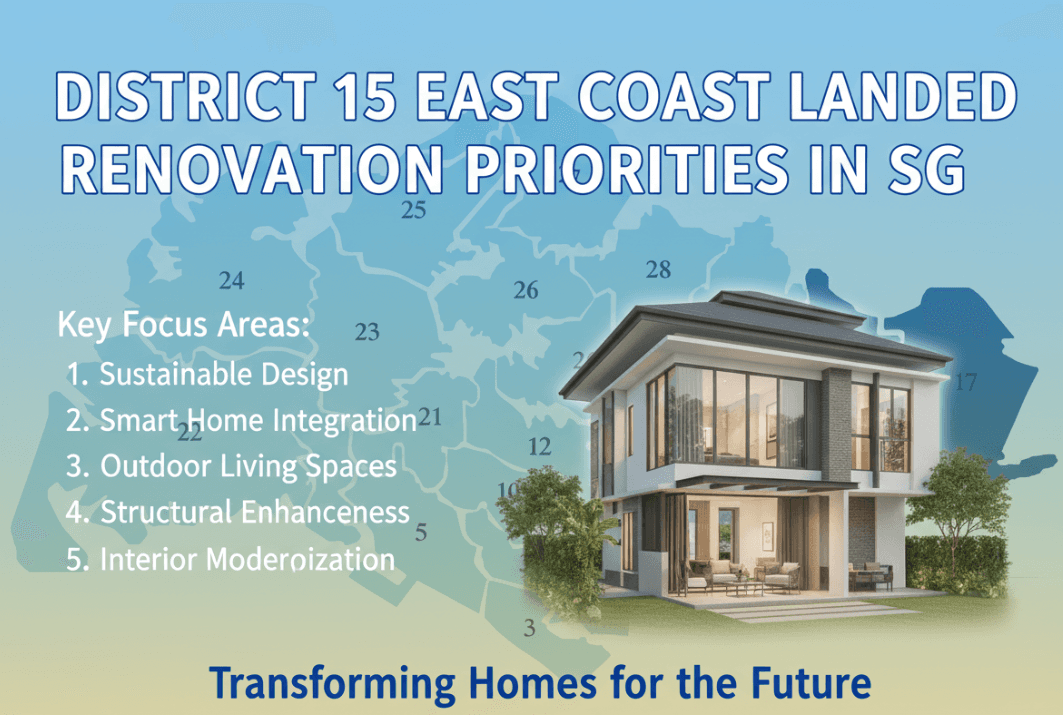
What District 15 landed buyers typically prioritise in renovation
Based on post-purchase renovation patterns, District 15 homeowners usually focus on three key areas:
1. Waterproofing, envelope, and coastal resilience
In East Coast landed homes, the first real issues discovered are often:
roof membrane degradation
external wall seepage
bathroom leakage
drainage inefficiencies
This is exacerbated by:
proximity to coast
higher groundwater conditions
older construction detailing
2. Space optimisation within tight planning constraints
District 15 homeowners commonly want:
better kitchen–dining integration
improved vertical circulation
additional rooms without increasing footprint
more daylight and ventilation
However, constraints such as:
plot ratio limits
boundary setbacks
existing structural layouts
mean that smart A&A planning matters more than raw budget.
3. Structural rationalisation before aesthetic upgrades
Many District 15 homes have undergone:
multiple past renovations
partial extensions
undocumented alterations
New owners often underestimate the need to:
rationalise structure
regularise past works
align layout with current regulations
This frequently pushes projects into A&A territory, even when owners initially planned “simple renovation”.
What Exactly Is A&A Work? A Simple Guide for Singapore Homeowners
A&A vs rebuild in District 15: what usually tips the scale
Despite high transaction prices, rebuild is not always the default in District 15.
A&A is often preferred when:
structural frame remains viable
spatial needs can be met through reconfiguration
owners want faster completion
neighbourhood character is a consideration
Rebuild becomes attractive when:
past renovations compromise structure
waterproofing issues are systemic
layout inefficiencies are beyond correction
long-term multigenerational planning is required
Why District 15 owners often underestimate renovation complexity
A common District 15 pattern:
Buyer focuses on charm and location
Renovation assumed to be cosmetic
Technical issues surface after hacking
Scope expands mid-project
This is where price paid vs renovation reality becomes relevant.
Price Paid vs Renovation Reality: What Singapore Landed Buyers Commonly Underestimate
Why early contractor involvement matters more in District 15
District 15 projects benefit greatly from early engagement with a landed house contractor because:
site constraints are tighter
waterproofing and drainage risks are higher
approval coordination is more sensitive
sequencing errors are costly
Early contractor input helps:
align design with buildability
reduce redesign and variation orders
manage regulatory and technical risk upfront
How Ember Earther Builders approaches East Coast landed projects
For District 15 homes, Ember focuses on:
early technical assessment
envelope and waterproofing strategy
compliance-aware space planning
realistic sequencing and phasing
This planning-first approach helps homeowners avoid charm-led decisions that become construction headaches.
If you’ve recently bought a landed home in District 15 (Katong, Joo Chiat, Siglap, East Coast) and are planning renovation, A&A, or rebuild works, early engagement with a landed house contractor can prevent costly surprises later.
Ember Earther Builders supports East Coast landed homeowners with clarity-first planning, before construction begins.
FAQ
Are District 15 landed homes harder to renovate than OCR areas?
They often require more waterproofing and compliance planning due to age and coastal conditions.
Is A&A more common than rebuild in District 15?
Yes. Many owners pursue A&A to optimise space while managing cost and timeline.
Does freehold tenure make renovation easier?
No. Tenure affects value, not renovation complexity
Related