Development
How Long Does a Landed House Rebuild Take? Timeline Breakdown
-
Renee Ang
How Long Does a Landed House Rebuild Take in Singapore? (Realistic Timeline)
Rebuilding a landed home is one of the most rewarding projects a homeowner can undertake, especially for those who have purchased older houses in places like Serangoon Gardens, Thomson, Kovan, Frankel, Opera Estate, and Upper Bukit Timah.
But the most common question homeowners (especially condo upgraders) ask is:
“How long does it actually take to rebuild a landed house in Singapore?”
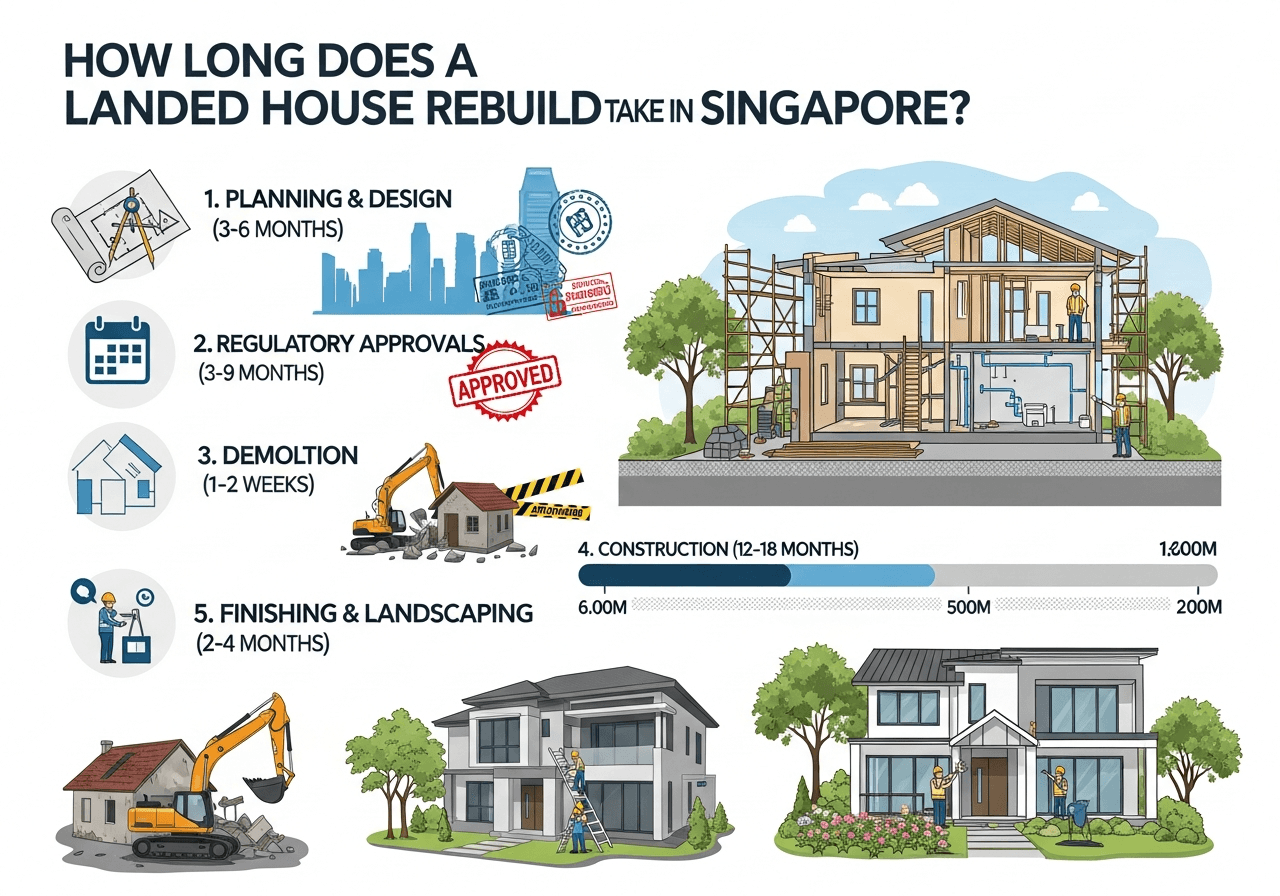
The honest answer: 18–30 months, depending on design complexity, approvals, structural needs, and whether the home includes an attic, basement, or lift.
Below is a realistic breakdown used by architects and builders in Singapore, with examples drawn from actual landed neighbourhoods.
1. Design & Planning Phase (1–3 Months)
This is where everything begins.
During this period, the architect works with you to lock down:
Floor plan layout
Number of storeys
Attic / basement feasibility
Open vs enclosed kitchen
Position of staircase
Bedroom arrangements
Master suite sizing
Façade style
In estates like Serangoon Gardens or Thomson, where land parcels are irregular or narrow, more time may be needed to optimise space.
Why this phase matters
Good planning reduces costly changes later.
Condo upgraders often need extra time here because they’re transitioning from pre-designed condo layouts to fully customised landed floor plans.
2. Authority Submission to URA & BCA (3–6 Months)
This is the part most homeowners underestimate.
A full rebuild requires approval from:
URA, for envelope control, height limits, building form
BCA, for structural design & demolition permits
PUB, if drainage or sewer line upgrades are needed
SCDF, fire safety clearance
NParks, if there are mature trees or green buffers
Homes in older estates like Frankel, Opera Estate, and Siglap often require additional drainage approvals due to proximity to low-lying areas.
Why approvals take time
Authorities review:
Structural safety
Neighbour impact
Fire access (especially for semi-Ds and bungalows)
Setback compliance
Basement waterproofing strategy
Re-submissions may be required. It's normal.
Total expected time: 3–6 months.
3. Demolition Works (2–4 Weeks)
Once approvals come through, demolition begins.
Steps include:
Disconnect utilities
Erect hoarding
Remove roof
Tear down slabs and beams
Clear debris
Level the land
Narrow roads like those in Joo Chiat, Telok Kurau, and Serangoon Gardens may extend this stage slightly due to limited truck access.
4. Foundation & Structural Construction (4–6 Months)
This is the most significant part of the rebuild.
Structural works include:
Foundation strengthening or new piles
Columns, beams, slabs
Attic floor construction
Staircase
Pitched or flat roof structure
Terraces in Frankel / East Coast often require more robust foundation work because soil conditions near coastal zones can vary.
Semi-Ds in Thomson, Windsor Park, and Watten Estate may require more complex structural design if owners want to extend or add an attic.
Why this stage is slow
Concrete requires curing time.
Engineers need to inspect works frequently.
Weather may delay certain stages.
5. Brickwork, Roofing & External Shell (2–3 Months)
Once the structure is complete, the building envelope forms.
This includes:
External and internal brick walls
Window openings
Roof waterproofing
Façade preparation
If the design includes a modern façade with stone cladding or aluminium fins, preparations begin here.
6. Mechanical, Electrical, Plumbing (M&E) Works (2–3 Months)
This is a critical stage because M&E determines day-to-day comfort.
Tasks include:
Electrical wiring
Plumbing
Aircon trunking
Water heater piping
DB box configuration
Smart home conduit provision
Older houses often have outdated plumbing systems, so this is a major upgrade, especially appreciated by condo upgraders accustomed to newer infrastructure.
7. Window Installation, Waterproofing & Flooring (1–2 Months)
These elements ensure long-term durability.
Windows
Popular in terrace houses with limited natural light (e.g., Kovan, Serangoon Gardens):
Full-height sliding panels
Casement windows
Window walls
Waterproofing
Critical in:
Bathrooms
Balconies
Roof terraces
Basement walls (if applicable)
Flooring
Choices include:
Porcelain tiles
Vinyl
Timber
Marble (for premium homes in Bukit Timah)
8. Carpentry, Kitchens, Wardrobes & Interior Fitting (2–4 Months)
This is often the most time-consuming interior stage.
Carpentry includes:
Kitchen cabinetry
Wardrobes
TV console
Storage systems
Shoe cabinets
Study room built-ins
Feature walls
For families upgrading from condos, this stage is particularly important since condo layouts are usually storage-efficient, and they want to replicate or exceed that convenience.
9. External Works (1–2 Months)
The home is nearly ready, but the exterior still needs work.
These include:
Car porch roofing
Boundary wall
Auto gate installation
Outdoor tiling
Landscaping
Drainage adjustments
Terraces and semi-Ds in the East Coast (Frankel, Siglap) may need enhanced drainage due to low-lying surroundings.
10. Final Defects Check & Handover (2–4 Weeks)
The builder walks through the house with you and checks:
Electrical safety
Water pressure
Waterproofing
Finishing quality
Touch-up painting
Cabinet alignment
Window sealing
Once everything is rectified, the home is ready for move-in.
Typical Total Rebuild Timelines by Property Type
Property Type | Typical Duration |
Intermediate Terrace | 18–24 months |
Corner Terrace | 20–26 months |
Semi-Detached | 20–28 months |
Bungalow / Detached | 24–30 months+ |
Basement Projects | Add 3–6 months |
Why Some Projects Take Longer Than Expected
Here are common reasons, based on real experiences across Singapore:
✔ Multiple re-submissions to authorities
Occurs more often in Bukit Timah, Thomson, or houses near green buffers.
✔ Design changes mid-way
Especially common among condo upgraders adjusting to landed living.
✔ Material delays
Imported stone or façade elements may face shipping delays.
✔ Tight roads or limited access
Happens in Joo Chiat, Opera Estate, Serangoon Gardens.
✔ Wet weather
December to February construction slows down due to rain.
✔ Basement construction challenges
Requires meticulous waterproofing and soil retention.
Tips for Homeowners Planning a Rebuild
1. Don’t rush the design stage
Good design saves months later.
2. Keep communication clear
Weekly updates from your builder keep the project smooth.
3. Give yourself a realistic move-in buffer
Always assume minor delays, 1–2 months buffer is common sense.
4. Choose quality over speed
A house that lasts 50 years shouldn’t be rushed.
Useful Links
To understand what influences rebuild budgets:
🔗 Cost to Rebuild a Landed House in Singapore (2026 Guide)
If you're deciding between A&A or a full rebuild:
🔗 Rebuild vs A&A: Which Option Is Better?
For homeowners beginning their rebuilding journey:
🔗 Landed House Rebuild Contractor Singapore
If you're exploring full demolition options:
🔗 Tear Down & Rebuild Singapore
Related