Development
District 19 Landed Renovation Trends: What URA Transactions Suggest New Owners Will Do Next
-
Su Shiquan

District 19 Landed Renovation Trends (2026): What URA Transactions Tell New Homeowners
District 19, covering Serangoon, Kovan, Rosyth, and surrounding landed enclaves, consistently ranks among Singapore’s most active landed housing markets.
But transaction volume alone doesn’t tell the full story.
From a landed house contractor’s perspective, what matters more is this:
What do buyers typically do after they purchase a landed home in District 19?
By analysing recent URA landed transaction records and pairing them with real renovation outcomes, we can see clear patterns in A&A demand, renovation scope, and rebuild decision-making.
This article breaks those patterns down, so new District 19 homeowners can plan correctly before renovation costs spiral.
Why District 19 behaves differently from other landed districts
District 19 has a unique mix of:
mature landed estates (Serangoon Garden, Rosyth)
strong family-upgrader demand
relatively older building stock
high price-per-square-foot driven by location, not condition
As a result, renovation decisions in District 19 are rarely straightforward.
Many homeowners enter expecting “simple renovation”, and discover they are actually facing A&A-level complexity.
Snapshot: Selected URA landed transactions in District 19 (recent)
Below is a representative sample of recent landed resale transactions in District 19, extracted from URA records (late 2025).
Sale Period | Estate / Street | Property Type | Land Area (sqft) | Price (SGD) | $PSF | Tenure |
Late 2025 | Rosyth Avenue | Detached | ~8,100 | ~10.2M | ~1,250 | Freehold |
Late 2025 | Tavistock Avenue (Serangoon Garden) | Semi-D | ~3,120 | ~7.2M | ~2,300 | 999-yr |
Late 2025 | Serangoon Garden Way | Semi-D | ~2,880 | ~6.9M | ~2,400 | 999-yr |
Late 2025 | Sirat Road | Terrace | ~2,450 | ~7.3M | ~3,000 | 999-yr |
Late 2025 | Coniston Grove | Terrace | ~1,840 | ~5.7M | ~3,100 | 999-yr |
Late 2025 | Kovan Road | Terrace | ~2,980 | ~5.7M | ~1,900 | Freehold |
What this data tells us (beyond prices)
High $PSF does not equal new condition
Many high-PSF homes are older stock with strong location appeal.Terrace and Semi-D dominate transactions
This strongly correlates with A&A-heavy renovation demand, not rebuild-only decisions.Tenure is strong, but building age is often old
Which means renovation complexity is usually hidden, not obvious during viewing.
What District 19 homeowners typically renovate first
Based on actual post-purchase renovation behaviour, most District 19 owners focus on three priorities:
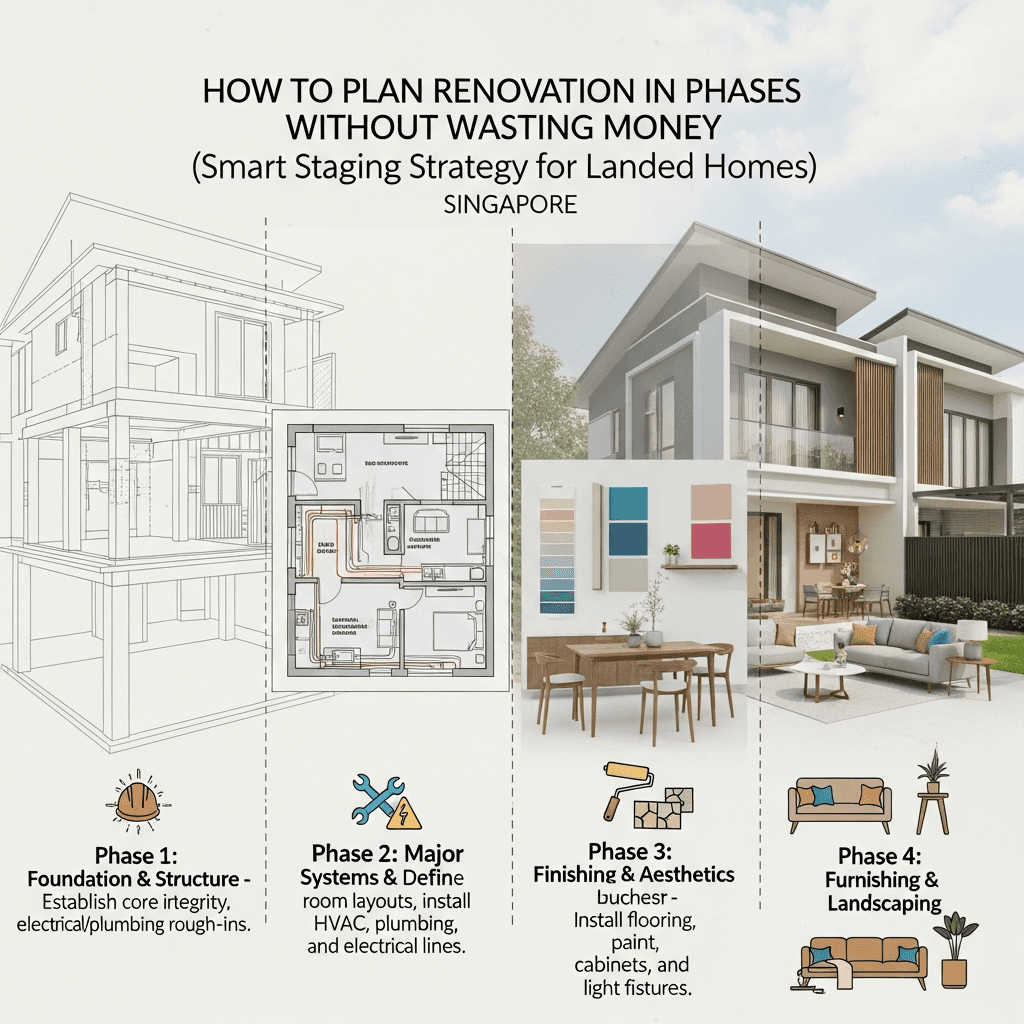
1. Structural clarity before aesthetic upgrades
In older landed homes, owners quickly discover:
wall removals aren’t always straightforward
floor level adjustments affect drainage
past renovations weren’t always documented
This often pushes projects from “renovation” into A&A territory.
What Exactly Is A&A Work? A Simple Guide for Singapore Homeowners
2. Space optimisation without full rebuild
Common District 19 needs:
improved kitchen and dining flow
additional bedrooms or study spaces
better stair positioning
more natural light
Instead of rebuilding, many owners pursue:
rear extensions
internal reconfiguration
attic or roof optimisation (where allowed)
3. Waterproofing, drainage, and envelope upgrades
This is the least glamorous, and most critical, category.
In estates like Serangoon Garden:
ageing roof systems are common
drainage was designed for older rainfall assumptions
repeated past renovations compound leakage risk
A&A vs rebuild in District 19: what actually drives the decision
Despite high transaction prices, rebuild is not always the default choice.
A&A is usually chosen when:
structure is fundamentally workable
layout issues can be solved through reconfiguration
owners want faster completion
budget and risk control matter
Rebuild is considered when:
structural limitations are severe
layout is beyond saving
cumulative A&A cost approaches rebuild levels
long-term family needs demand a fresh start
Why many District 19 owners delay renovation, and regret it
A common pattern:
Purchase stretches budget
Renovation feels overwhelming
Owners delay decisions
Hidden issues worsen over time
This often results in:
higher rectification cost
rushed planning later
reduced contractor availability
Why Many New Landed Owners Delay Renovation for 6–12 Months (And What It Really Costs)
Why District 19 renovations benefit from early contractor involvement
District 19 landed homes are rarely “standard”.
Early involvement of a landed house contractor helps:
identify A&A triggers early
align design with compliance realities
sequence works efficiently
reduce redesign and variation orders
This is especially important where:
past renovations exist
boundary conditions are tight
drainage and structural constraints interact
How Ember Earther Builders approaches District 19 projects
Rather than starting with finishes or packages, Ember focuses on:
early technical assessment
regulatory clarity
scope alignment
realistic sequencing
This approach is particularly effective in Serangoon Garden, Rosyth, and Kovan landed estates, where renovation success depends more on planning than appearance.
If you’ve recently bought a landed home in District 19 (Serangoon, Kovan, Rosyth) and are planning renovation, A&A, or rebuild works, engaging a landed house contractor early can help you avoid unnecessary cost and delay.
Ember Earther Builders supports District 19 homeowners with clarity-first planning, before construction begins.
FAQ
Is District 19 more renovation-heavy or rebuild-heavy?
Renovation and A&A dominate, with rebuilds occurring mainly when structural or layout limits are severe.
Are Serangoon Garden landed homes harder to renovate?
They often require more technical planning due to age, drainage, and past renovation layers.
Should I rebuild just because prices are high?
No. Transaction price reflects land value, not renovation necessity.
Related