Development
A&A vs Renovation: Key Differences in Singapore Regulations
-
Renee Ang
A&A vs Renovation: Key Differences in Singapore Regulations
If you’ve just purchased an older landed home in Singapore, maybe a terrace in Opera Estate, a semi-D in Serangoon Gardens, or a bungalow in Bukit Timah, you’re likely asking the same question most homeowners ask:
Should I do renovation or A&A? What’s the difference in Singapore?
Although people often use “renovation” and “A&A” interchangeably, they are not the same.
In Singapore, BCA (Building and Construction Authority) and URA regulations clearly distinguish the two, and choosing the wrong category can cause delays, stop-work orders, and unnecessary costs.
This guide explains the differences in simple, practical terms, with real examples from landed estates across Singapore.
1. What Counts as Renovation in Singapore?
Renovation refers to non-structural works that do not alter the building’s main framework.
Renovation typically includes:
replacing flooring
painting
carpentry and built-ins
changing doors or windows (not enlarging openings)
kitchen refresh
bathroom upgrades
lighting replacement
rewiring (minor, internal)
AC replacement
plastering
waterproofing improvements
Renovation DOES NOT require BCA structural submissions.
It’s fast, affordable, and minimally disruptive.
Renovation Is Suitable For:
✔ Homes built in the 2000s or newer
E.g., landed clusters in:
Luxus Hill
Westwood Park
Punggol Field Walk
These often have good structures but dated interiors.
✔ Homes with modern layouts already
Open-concept layouts in newer semi-Ds and terraces in:
Lentor private enclave
Springleaf
Holland Grove
only need interior upgrades.
✔ Owners who just want cosmetic changes
New paint, new kitchen, new tiles, renovation is ideal.
✔ Homeowners who plan to rent out the property
Renovation refreshes the unit without heavy spending.
2. What Counts as A&A in Singapore?
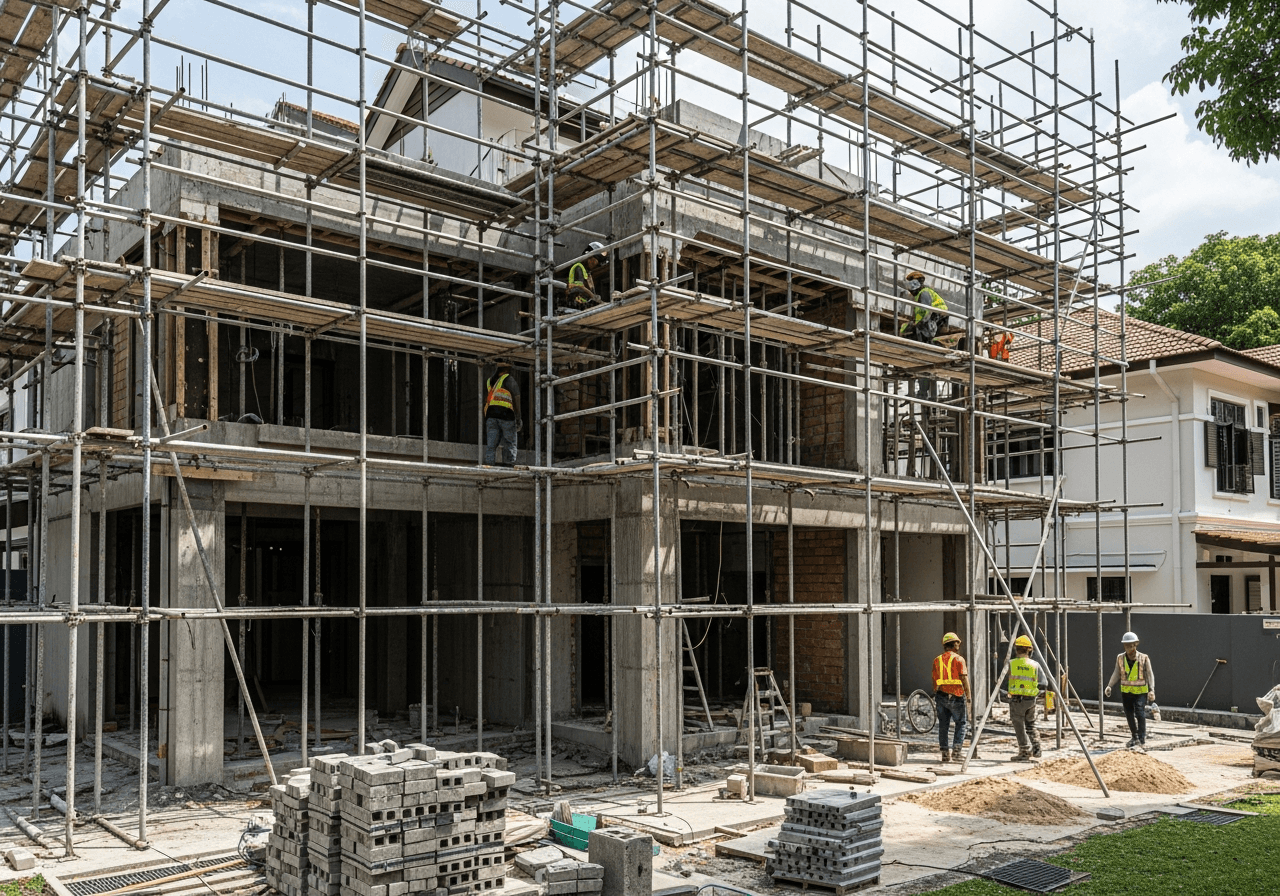
Additions & Alterations (A&A) refer to works that modify, extend, or upgrade the structure, but WITHOUT demolishing the main structural framework.
A&A includes:
adding a room
rear extension
enlarging kitchen or dining area
adding a bathroom
shifting internal walls
new staircase design
partial roof changes
new façade
adding mezzanine floor
modifying window sizes
redesigning front elevation
major M&E system upgrade
A&A requires BCA compliance and PE (Professional Engineer) involvement.
It is far more substantial than renovation.
A&A Is Suitable For:
✔ Older landed homes (30–50 years old)
Examples:
Serangoon Gardens
Frankel Estate
Opera Estate
Thomson Ridge
Seletar Hills
Sunset Way / Clementi Park
Older homes usually have outdated layouts that can only be improved through A&A.
✔ Homes with good structure but inefficient layout
Long, narrow terraces in Telok Kurau, Jalan Daud, Kovan, or Upper Serangoon often need:
open-concept living
better airflow
skylights
kitchen expansion
Renovation alone cannot achieve this.
✔ Homeowners who need functional upgrades
A&A is perfect when you want:
bigger family area
helper’s room
bathroom for each bedroom
brighter interiors
better ventilation
modern façade
**3. The MOST Important Difference: Structural Impact
Renovation = No structural impact
A&A = Some structural impact
Rebuild = Complete structural overhaul
Here’s the breakdown:
Work Type | Structural Work? | Approval Needed? | Typical Cost |
Renovation | No | No BCA | $20k – $200k |
A&A | Yes, minor to moderate | Yes | $200k – $600k+ |
Rebuild | Yes, major | Yes (full submissions) | $650k – $3M+ |
4. What BCA Says: When Renovation Becomes A&A
Your project is automatically classified as A&A if you:
A. Add or Remove Structural Walls
This includes:
knocking down load-bearing walls
adding new structural beams
relocating columns
Common scenarios:
Older semi-Ds in Thomson and Serangoon Gardens often have beams in awkward places.
Shifting them = A&A.
B. Extend the House
Any extension, front, side, or rear, counts as A&A.
Examples:
Terraces in Opera Estate extending kitchens
Semi-Ds in Sunset Way expanding dining areas
Corner terraces in Seletar Hills adding side rooms
C. Modify Roof Structure
Changing roof shape, slope, or rafters triggers A&A submissions.
D. Add New Rooms or Bathrooms
Especially when involving plumbing, waterproofing, or structural changes.
E. Alter Window Openings
Enlarging windows or adding new ones affects façade and structural integrity.
F. Create Mezzanines
Mezzanines require careful structural checks to avoid overloading the slab.
5. What Is NOT Allowed Under A&A?
There is a limit to how much you can change.
If you exceed it, the project becomes a rebuild.
Here’s what A&A cannot do:
❌ You cannot demolish more than X% of the structure
Exact percentage is not published, but experienced contractors know that:
If most beams, columns, and slabs are removed, it’s considered a rebuild.
Common mistake:
Homeowners in older areas like Siglap, Bedok South, Pasir Panjang try aggressive A&A that unintentionally crosses rebuild boundaries.
❌ You cannot add full additional floors
A two-storey house cannot become a three-storey house under A&A.
Small attic adjustments are allowed, but not a full extra floor.
❌ You cannot change the entire building envelope
Large roof alterations or major façade removals can reclassify the project.
❌ You cannot exceed URA setback or height control
Especially relevant in:
Frankel / Opera Estate (strict envelope rules)
Joo Chiat (conservation influence)
Binjai Park (slope profiles)
6. Key Regulatory Differences: A&A vs Renovation
A. Approval Requirements
Category | Renovation | A&A |
BCA Submission | ❌ Not required | ✅ Required |
PE Endorsement | ❌ No | ✅ Yes |
Structural Drawings | ❌ No | ✅ Yes |
Authority Checks | Low | High |
B. Timelines
Category | Renovation | A&A |
Design | 1–4 weeks | 4–8 weeks |
Approvals | None | 1–3 months |
Construction | 1–4 months | 3–9 months |
C. Cost Differences
Renovation: $20k–$200k
A&A: $200k–$600k+
A&A costs more because of:
engineering fees
authority submissions
structural works
waterproofing
M&E enhancements
7. Real Examples From Singapore Neighbourhoods
Example 1, Renovation (Thomson Garden Estate)
Young family upgrades:
flooring
lighting
kitchen
bathrooms
Good structure → renovation was sufficient.
Example 2, A&A (Serangoon Gardens Semi-D)
Owner wanted:
bigger dining
new bathroom
proper helper’s room
brighter living room
Required wall removal + structural extension → A&A category.
Example 3, A&A (Telok Kurau Terrace)
To improve airflow & lighting:
added skylight
reconfigured staircase
enlarged kitchen
A&A was chosen to avoid full rebuild timeline.
8. How to Decide: Should You Do Renovation or A&A?
Ask yourself these questions:
✔ Is the house more than 25–30 years old?
If yes → A&A likely needed.
✔ Do I want to extend or enlarge existing spaces?
If yes → A&A.
✔ Do I want to change the roof profile or façade significantly?
If yes → A&A.
✔ Do I need more bathrooms or helper’s space?
If structural → A&A.
✔ Is ventilation and lighting an issue?
Terraces in Opera Estate and Telok Kurau almost always require A&A to fix airflow problems.
✔ Is the house structurally compromised?
In older areas like Frankel, Serangoon North, Bedok South, A&A is often the safer option.
Useful Links
To engage a team that handles full A&A compliance and submissions:
🔗 A&A Contractor Singapore
If you’re unsure whether you need A&A or full reconstruction:
🔗 Landed House Rebuild Contractor Singapore
🔗 Renovation, A&A, or Rebuild, Which Should You Choose?
For homeowners planning extensions or space expansion:
🔗 How to Expand Your Landed Home Legally Using A&A Works
For detailed cost breakdowns:
🔗 How Much Does A&A Work Cost in Singapore?
To understand what BCA allows before proposing changes:
🔗 A&A Guidelines for Singapore Landed Homes, What BCA Allows & Doesn’t Allow
Related