Development
Semi-D Landed Renovations: Structural and Waterproofing Risks New Owners Overlook
-
Su Shiquan

Semi-Detached Landed Renovations in Singapore: Structural & Waterproofing Risks New Owners Overlook
Semi-detached houses sit in a unique position in Singapore’s landed market.
They offer:
larger land than terraces
more flexibility
stronger capital appreciation
But from a landed house contractor’s perspective, semi-D renovations often carry higher structural and waterproofing risk than terrace houses, especially when owners underestimate A&A triggers.
This article explains:
what recent semi-D transactions signal
the most common structural mistakes
waterproofing traps
when renovation quietly becomes A&A
and how to control risk early
Recent Semi-D Transactions & Typical Renovation Direction
Estate / District | Land Area (sqft) | Price Range | PSF | Tenure | Common Renovation Path |
Serangoon Garden (D19) | ~2,900–3,600 | ~$6.8M–$7.5M | ~$2,200–$2,400 | 999-yr | A&A with rear/side extension |
Upper Serangoon | ~3,200 | ~$6.5M | ~$2,030 | Freehold | Staged A&A |
East Coast (D15) | ~3,000–3,400 | ~$7.4M–$8.2M | ~$2,500+ | Freehold | A&A with internal restructuring |
Bukit Timah fringe | ~3,500+ | ~$10M+ | ~$2,800+ | Freehold | Rebuild or heavy A&A |
Contractor Interpretation
Semi-Ds rarely justify immediate rebuild unless structural constraints are severe
Side setbacks create extension potential, but also regulatory exposure
Owners often push structural boundaries more aggressively than terrace buyers
The 3 Structural Risks Semi-D Owners Overlook
1. Side Extension Assumptions
Because semi-D houses have one open side, owners assume:
“We can just extend sideways.”
But side extensions are governed by specific setback and boundary rules.
Before planning any side extension, owners should understand:
Singapore landed house setback requirements for semi-detached houses
Why this matters:
Side setbacks vary by plot
Extensions can trigger A&A
Structural strengthening may be required
2. Removing “Non-Structural” Walls That Aren’t
Semi-D homes often:
share party walls
have structural beams hidden in ceiling voids
contain load-bearing walls assumed to be removable
Late discovery causes:
design freeze
engineering redesign
cost escalation
Before hacking, homeowners should understand:
How to identify structural vs non-structural walls in landed houses in Singapore
3. Slab Loading & Upper Storey Modifications
Semi-D owners often want:
larger bedrooms upstairs
balcony enclosures
attic additions
These modifications:
affect slab loading
may trigger structural review
often convert renovation into A&A
Before committing, owners should review:
Common renovation works that trigger A&A requirements in landed homes
Waterproofing & Drainage: The Silent Budget Killer
Semi-D houses are particularly vulnerable because:
Roof spans are larger
Side walls are exposed to weather
Drainage alignment may conflict with new layouts
Common issues discovered mid-renovation:
water ingress from neighbour side
inadequate falls after extension
mismatched waterproofing systems between phases
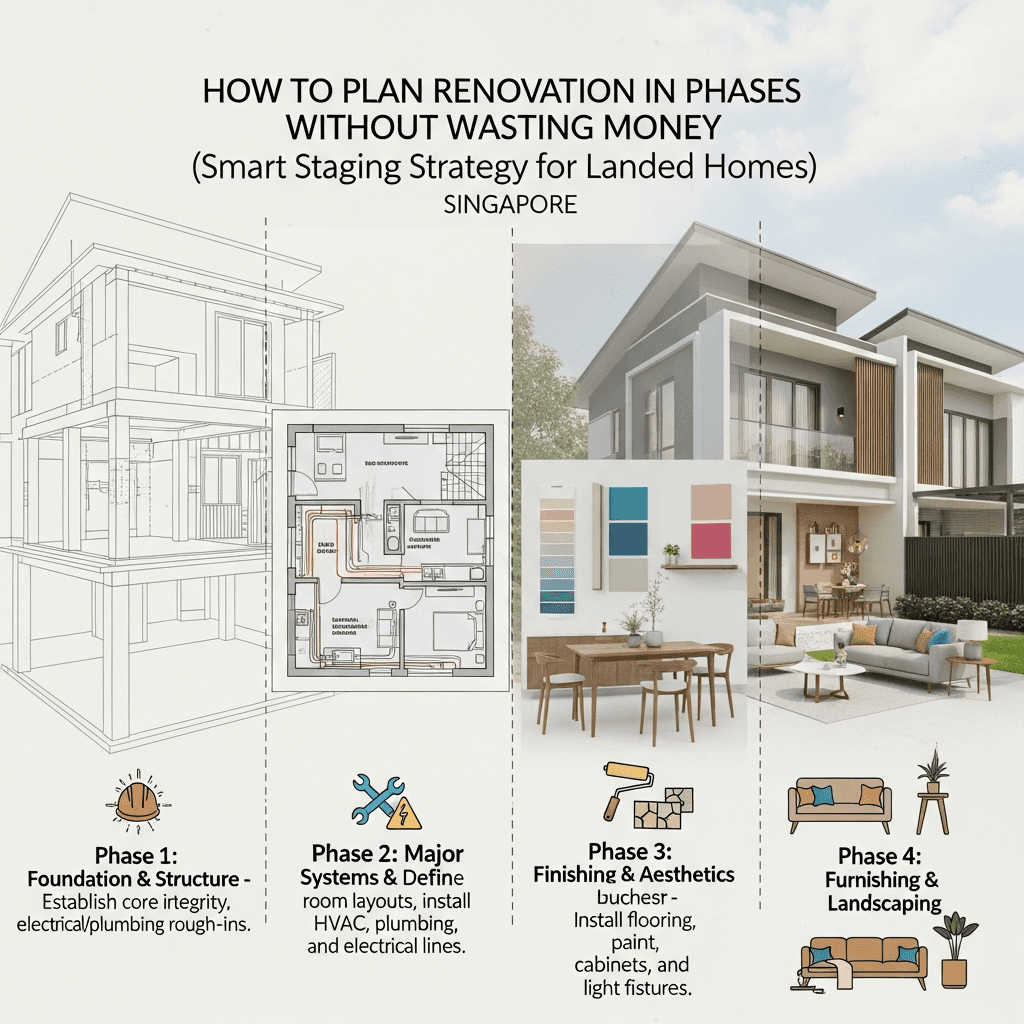
This is why drainage should be planned holistically, not per stage.
How to Renovate an Old Landed House Safely
When Semi-D Renovation Quietly Becomes A&A
Renovation becomes A&A when:
Extensions alter building footprint
Structural walls are removed
Slab loading is modified
Height or attic modifications occur
Understanding these triggers early prevents:
approval delays
variation orders
contractor re-sequencing
A&A vs Renovation: Key Differences in Singapore Regulations
Semi-D: Renovation vs A&A vs Rebuild (Quick Decision Grid)
Scenario | Recommended Path | Risk Level |
Layout reconfiguration only | Renovation | Low |
Side or rear extension | A&A | Medium |
Major structural inefficiency | Heavy A&A | Medium–High |
Severe structural limitation | Rebuild | High |
Rebuild vs A&A: Which Is Better for Your Landed Home?
Why Early Contractor Involvement Matters More for Semi-D
Semi-D homes combine:
terrace-level constraints
detached-level ambition
Without early contractor input, projects risk:
structural misjudgment
compliance oversight
waterproofing discontinuity
This is why homeowners searching
“landed house contractor Singapore”
are often semi-D owners facing structural uncertainty.
How Ember Earther Builders Approaches Semi-D Renovations
Ember focuses on:
Early structural feasibility checks
Side setback compliance validation
Targeted strengthening instead of blanket engineering
Holistic waterproofing design
This approach reduces:
redesign loops
A&A surprises
unnecessary rebuild decisions
If you own a semi-detached landed home in Singapore and are planning renovation, extension, or A&A works, early consultation with a landed house contractor can prevent structural and regulatory mistakes before construction begins.
Ember Earther Builders supports semi-D homeowners across District 19, District 15, and Bukit Timah with clarity-first planning.
Related