Development
Should You Add a Pool to Your Landed Home in Singapore?
-
Su Shiquan

A private pool can make a landed home feel like a personal retreat. It offers a place to cool off on a warm afternoon, spend time with family or simply enjoy a peaceful view from your living room.
But a pool is also a long-term commitment. Beyond the initial construction, homeowners need to consider how much space it will take up, how often it will be used and what it will cost to maintain.
So, is a pool the right addition to your home? Here are the key considerations—and some practical ideas for landed homes in Singapore.
1. Start with how you want to use the pool
Before thinking about tiles or poolside loungers, consider what you want the pool to do for your household. The answer will influence its size, depth, layout and features.
Ask yourself:
Will you use it mainly for exercise, relaxation or family time?
How often does your household expect to swim?
Do you have young children, elderly family members or pets to consider?
Would you prefer more water space or more room for a garden and outdoor dining?
Are you comfortable with the ongoing care a pool requires?
A pool designed around your lifestyle is more likely to be enjoyed than one chosen simply because it looks impressive.
Ideas for different lifestyles
For relaxation: A compact plunge pool with a built-in bench can be ideal for cooling off without taking over the entire garden.
For exercise: A lap pool offers a longer swimming route, but make sure the usable length suits your expectations. A narrow pool may look attractive without necessarily providing a satisfying swim.
For families: Consider a layout with easy-to-use steps, a comfortable gathering area and good visibility from the house.
For entertaining: Position the pool near a sheltered patio or outdoor dining area, leaving enough dry space for guests to move around comfortably.
2. Look beyond the size of the pool
It can be tempting to fit the largest possible pool into the available space. But the pool itself is only one part of the layout.
You will also need to consider:
Space to walk safely around the pool
Access for cleaning and maintenance
An area for pumps, filters and other equipment
Drainage and electrical services
Landscaping, seating and shelter
Access between the pool and the house
A useful exercise is to sketch out the whole outdoor area, not just the pool. Think about where family members will enter the water, where wet feet will go after a swim and whether there is still room for the activities you enjoy.
For example, a smaller pool with a generous patio may serve your family better than a larger pool surrounded by narrow walkways.
Practical ideas for different landed homes
Intermediate terrace house: If outdoor space is limited, explore a compact plunge pool in the rear garden or courtyard. Keep the surrounding layout simple and consider how the pool equipment can be accommodated discreetly.
Semi-detached or corner terrace house: A side or rear garden may offer opportunities for a longer, narrower pool. Consider how the pool relates to neighbouring homes, windows and outdoor seating areas.
Detached house: With more space, you may be able to combine a family pool with a garden and entertaining area. Even so, it is worth considering whether a larger pool will be used enough to justify its additional upkeep.
Every site is different, so these are starting ideas rather than guarantees that a pool will fit or be approved.
3. Consider Singapore’s climate
Singapore’s warm weather makes a pool appealing throughout the year, but it also affects how you should design the surrounding space.
Plan for shade
A sunny pool can be inviting, but too much direct sun may make the deck uncomfortable during the day. Consider a sheltered patio, an umbrella or carefully positioned landscaping where family members can sit out of the sun.
Think about where shadows fall at different times of day. A spot that feels comfortable in the morning may be exposed in the afternoon.
Choose practical surrounding materials
Poolside surfaces should be comfortable to walk on, suitable for wet conditions and easy to maintain. When comparing finishes, ask to see samples and check how they feel when wet and exposed to sunlight. For more guidance on outdoor finishes, read How to Choose the Right Materials for Singapore’s Weather.
Also consider where rainwater will go. Well-planned drainage helps prevent ponding on decks and walkways.
Think carefully about planting
Greenery can soften the look of a pool and provide privacy, but plants that shed heavily may mean more frequent cleaning. Choose landscaping with both appearance and maintenance in mind, and make sure plants do not obstruct access to equipment.
4. Plan for safety from the beginning
A pool should be designed for everyone who lives in or visits your home.
For households with children or non-swimmers, consider:
How easily the pool can be accessed from the house
Whether a secure barrier or gate is appropriate
Clear visibility of the pool from frequently used spaces
Non-slip finishes and secure handrails where needed
Steps or entry points that suit different users
No design feature replaces active adult supervision. Discuss your household’s needs with your design-and-build team early, so safety is part of the layout rather than an afterthought.
5. Understand the construction budget
There is no single price that applies to every landed-home pool in Singapore. Costs depend on the design and the condition of the site—not just the pool’s dimensions.
Factors that can affect your budget include:
Pool size, depth and shape
Excavation and ground conditions
Access for machinery and removal of excavated material
Structural design and waterproofing
Pool finishes, decking and landscaping
Pumps, filtration and water-treatment equipment
Professional fees and applicable submissions
Changes to existing drains, services or surrounding structures
For an existing home, restricted access can make construction more complicated. There may also be concealed conditions that are only confirmed after further investigation or work begins. Our guide to renovating an old landed house safely covers broader precautions when working on an existing property.
What to ask for in a quotation
Request an itemised quotation and check what is included or excluded. For example:
Does it include excavation and disposal?
Are waterproofing, pool finishes and decking included?
What equipment is specified?
Are professional fees and submissions included?
Does the price include reinstating affected areas?
What allowances have been made for unknown site conditions?
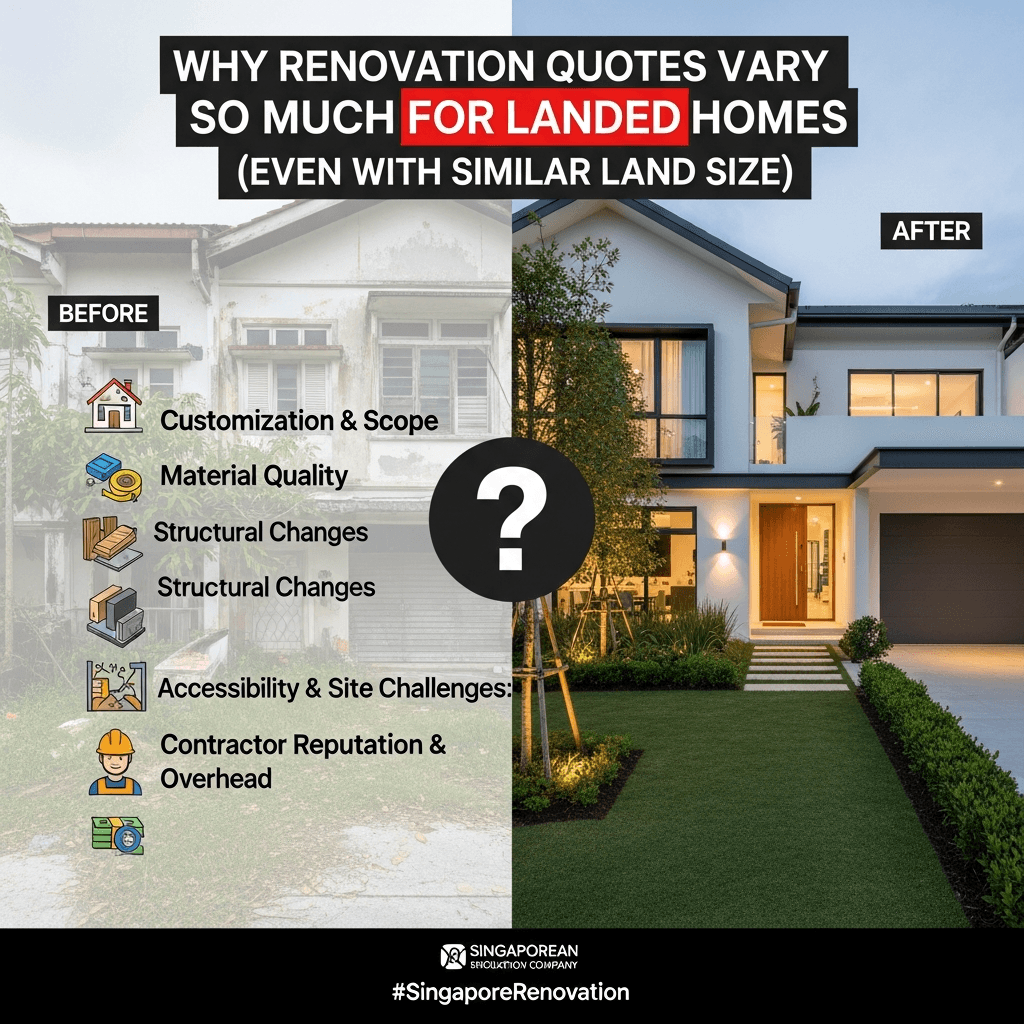
It is also sensible to set aside a contingency for unforeseen work. The appropriate amount will depend on how much is known about your property and the proposed scope. To better understand differences between proposals, read Why Renovation Quotes Vary So Much for Landed Homes.
6. Budget for life after construction
A pool continues to need care even when no one is using it. Alongside cleaning, the water needs regular testing and treatment, while pumps and filters require inspection and servicing.
Your ongoing budget may include:
Routine cleaning and maintenance visits
Water-treatment chemicals or consumables
Electricity for pumps and other equipment
Water top-ups
Repairs and eventual replacement of parts
Periodic attention to finishes and surrounding areas
When comparing maintenance packages, ask what the service provider actually includes. For example, are chemicals, filter cleaning and minor repairs covered, or charged separately? Also clarify what checks you will need to carry out between visits.
Don’t forget mosquito prevention
Good upkeep matters beyond the pool water itself. Check pool covers, deck drains, plant containers and other areas where rainwater might collect. The National Environment Agency advises homeowners to regularly check for and remove stagnant water, which can become a mosquito-breeding habitat. Read its mosquito prevention guidance.
7. Check what is possible before settling on a design
A pool’s location and design need to be considered alongside the property’s planning requirements, existing structures and site conditions.
Requirements can differ depending on factors such as whether the pool is raised or sunken, the type of landed home and its surroundings. There may also be building and structural considerations, especially when works are close to the house or neighbouring properties.
Before committing to a design, consult the appropriate qualified professionals to assess the site and advise on the submissions and approvals required. You can also refer to URA’s guidance on renovating land-titled residential properties. If the pool forms part of a wider renovation, our guide to what to prepare before starting A&A works on your landed home can help with early project planning.
8. Consider whether a pool is the best use of your space
A pool can be a wonderful addition, but it is not the only way to create an enjoyable outdoor area.
If your family prefers hosting meals, gardening or having open space for children to play, you might get more everyday use from a sheltered patio, landscaped garden or outdoor dining area.
You could also consider a smaller pool that leaves room for those activities. The best decision is the one that suits your household—not simply what looks most impressive in a photograph.
Is a pool right for your landed home?
A pool may be a good fit if your family will use it regularly, the layout works comfortably and you are prepared for the construction and maintenance costs.
On the other hand, if outdoor space is tight or you are unsure how often you will swim, it may be worth exploring a compact plunge pool—or prioritising another outdoor feature altogether.
The key is to plan for the whole experience: how the pool looks, how it works and how it fits into your daily life.
At Ember Earth Builders, we believe a well-designed home should be as practical as it is beautiful. If you are considering a pool as part of your landed home renovation or build, we can help you explore how it might fit into your overall design, lifestyle and project scope.
Related