Development
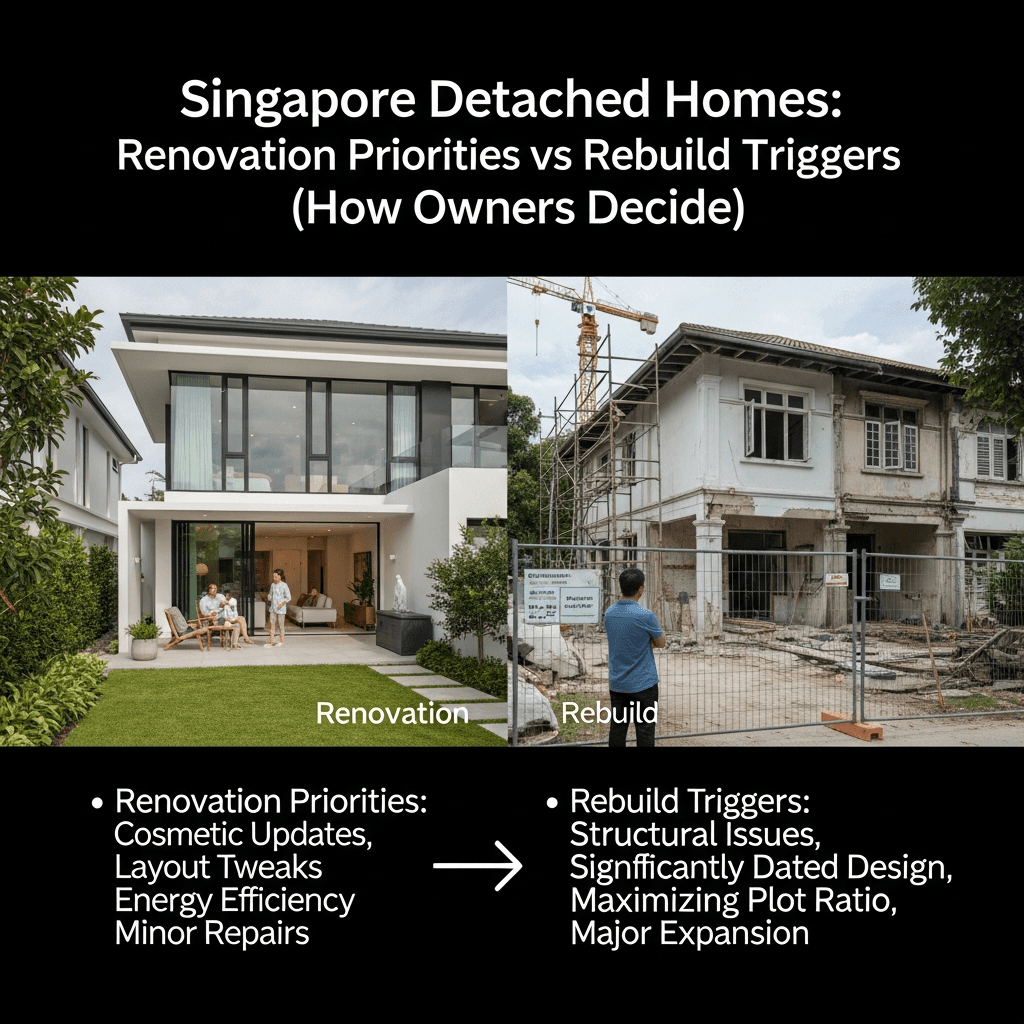
Detached Homes: Renovation Priorities vs Rebuild Triggers (How Owners Decide)
-
Su Shiquan
Detached House Renovation in Singapore: When to Renovate, A&A or Rebuild
Detached houses represent the top tier of landed living in Singapore.
They offer:
full boundary control
maximum extension flexibility
larger land area
greater design freedom
But from a landed house contractor’s perspective, detached homes are also where renovation decisions carry the highest financial and regulatory risk.
This article explains:
what recent detached transactions signal
when renovation works
when A&A becomes necessary
and when rebuild is the smarter long-term choice
Recent Detached Transactions & Renovation Direction
Estate / District | Land Area (sqft) | Price Range | PSF | Tenure | Typical Renovation Direction |
Watten Estate (D10) | ~7,000–8,500 | ~$16M–$20M | ~$2,400 | Freehold | Rebuild or heavy A&A |
Bukit Timah enclave | ~6,500–7,500 | ~$14M–$18M | ~$2,200 | Freehold | Major A&A |
East Coast prime pocket | ~5,000–6,000 | ~$10M–$13M | ~$2,300 | Freehold | A&A with extension |
Serangoon Garden high-end | ~5,500–6,500 | ~$9M–$11M | ~$1,900 | 999-yr | Renovation-first, staged A&A |
Contractor Interpretation
Large land area does not automatically justify rebuild
Detached homes offer flexibility, but also greater regulatory exposure
Structural feasibility matters more than price tag
The 4 Key Decision Factors for Detached Homes
1. Building Age & Structural Frame
Older detached houses may:
have inefficient structural grids
limit span expansion
complicate open-plan ambitions
If structural redesign becomes extensive, rebuild may be more logical.
Before deciding, owners should understand:
Height, storey and attic limits for landed residential properties in Singapore
allowable storeys
attic configurations
envelope constraints
2. GFA & Maximisation Misconceptions
Detached owners often assume:
“Since we have large land, we can maximise everything.”
In reality:
setback requirements apply
building footprint is controlled
GFA assumptions are often incorrect
Before planning extensions, owners should review:
Common misconceptions about maximising GFA in landed houses in Singapore
3. Drainage & Site Conditions
Large detached plots often:
have uneven gradients
require complex drainage coordination
face boundary condition constraints
When extending or rebuilding:
drainage redesign can become substantial
waterproofing systems must be unified
How to Renovate an Old Landed House Safely
4. Long-Term Family Planning
Detached homes are frequently:
multi-generational
legacy properties
long-term holds
This shifts the decision criteria from:
cost-only
to
lifecycle performance
Rebuild may be justified if:
layout inefficiency is severe
multi-generation accommodation is required
lift provision and accessibility are needed
Rebuild vs A&A: Which Is Better for Your Landed Home?
When Renovation Makes Sense for Detached Homes
Renovation (without A&A) works when:
layout changes are minor
structural system remains intact
extensions are unnecessary
waterproofing and services are manageable
Risk level: Low–Medium
When A&A Is the Smart Middle Ground
A&A is ideal when:
partial extensions improve layout
upper floor reconfiguration is needed
structural strengthening is targeted
timeline control matters
Risk level: Medium
When Rebuild Is the Rational Choice
Rebuild becomes logical when:
structural grid prevents meaningful reconfiguration
cumulative A&A cost approaches rebuild cost
long-term planning requires clean structural redesign
envelope efficiency is severely compromised
Risk level: High (financial + timeline)
Detached Houses & Regulatory Sensitivity
Detached homes face:
stricter scrutiny in prime districts
greater impact on neighbours
higher visibility of non-compliance
Before any major works, owners should understand:
Singapore landed house setback requirements for detached houses
Why Early Contractor Involvement Is Critical for Detached Homes
Detached projects often involve:
larger scope
higher structural intervention
longer approval cycles
more stakeholder coordination
Early engagement with a landed house contractor helps:
evaluate rebuild vs A&A objectively
prevent design overreach
coordinate compliance early
reduce redesign and variations
This is why high-value owners searching “landed house contractor Singapore” are usually facing major strategic decisions.
How Ember Earther Builders Approaches Detached Projects
Ember focuses on:
Early feasibility studies
Rebuild vs A&A cost modelling
Compliance-first design sequencing
Long-term structural performance
The goal is not maximum scope —
it is maximum clarity before commitment.
If you own a detached landed house in Singapore and are deciding between renovation, A&A, or rebuild, early consultation with a landed house contractor can prevent costly missteps before design fees escalate.
Ember Earther Builders supports detached homeowners across District 10, District 15, and District 19 with clarity-first planning.
Related